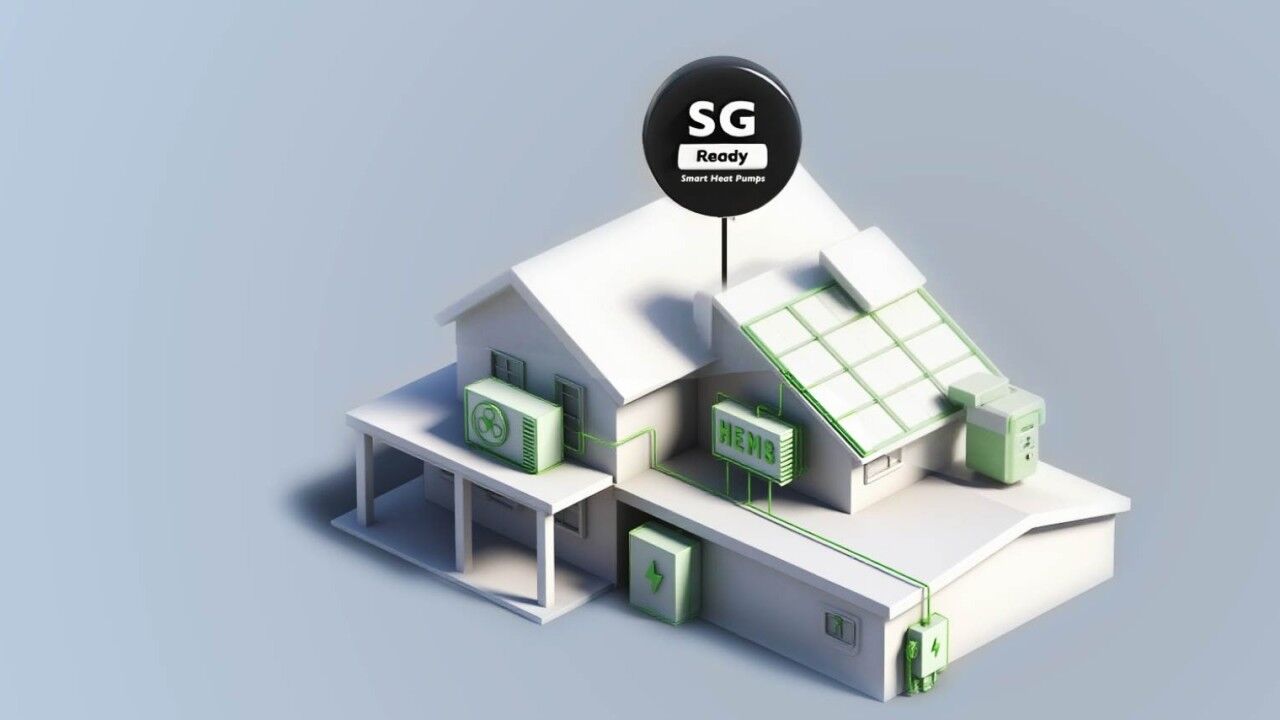
SG Ready: A Smart Grid Passport for Heat Pumps Going Global
In early 2023, Germany’s Federal Office for Economic Affairs and Export Control (BAFA) introduced a subtle but important shift in its heat pump subsidy policy: to qualify for federal incentives — covering up to 70% of the investment cost — heat pumps must be able to receive external control signals. This is exactly why the SG Ready label matters: it signals that a model is equipped with a standardized interface for third-party control, making it better aligned with the needs of an increasingly smart and flexible power system.
With one policy change, the SG Ready label has rapidly become a critical passport for Chinese heat pump manufacturers entering the European market.
I. What Is SG Ready?
Launched in 2012 by the German Heat Pump Association (BWP) and 17 heat pump manufacturers, the SG Ready label was designed to make heat pumps responsive to external control signals — such as dynamic electricity prices and grid load conditions. In doing so, it helps reposition heat pumps from simple energy-consuming devices to flexible assets that can actively support grid balancing.
With standardized interfaces such as EEBus and SG Ready, heat pumps can respond to external signals from grid operators — including dynamic price signals and grid congestion alerts — and adjust their operation in real time. This allows them to automatically absorb surplus solar power when renewable generation is abundant, while reducing or suspending operation during peak-price periods to optimize household energy costs.
II. The Four Operating Modes of an SG Ready Heat Pump
At its core, SG Ready establishes a standardized control logic for heat pump operation. Using two binary switching signals, it enables four distinct operating modes, allowing heat pumps to respond in a simple yet structured way to external control commands.
1. Blocked operation (1:0): In this mode, the heat pump may be temporarily blocked from operating for up to two hours per day.
2. Normal operation (0:0): The heat pump runs in its normal energy-efficient operating mode.
3. Recommended operation (0:1): In this mode, the heat pump is actively encouraged to operate, typically for space heating and domestic hot water production.
4. Forced operation (1:1): This mode can be divided into two scenarios:
a. Option 1: The heat pump is actively triggered to operate.
b. Option 2: The heat pump is switched on and raises the hot water temperature to a higher setpoint, using thermal storage capacity.
III. What Can SG Ready Do?
Help reduce electricity bills:
When integrated with dynamic electricity tariffs — such as time-of-use pricing in Germany — SG Ready enables heat pumps to operate during lower-price periods, helping reduce overall energy costs.
Support greater renewable energy integration
When paired with a PV system, SG Ready allows the heat pump to run during periods of strong solar generation and store heat in advance, increasing on-site consumption of clean energy.
Support grid stability:
By reducing load during peak periods and shifting heat pump operation to off-peak hours, SG Ready helps absorb available electricity more flexibly, balance grid demand, and contribute to overall system stability.
IV. Why SG Ready Matters for Heat Pump Manufacturers Entering Europe
Europe’s heat pump market is growing rapidly, but policy and compliance thresholds are rising just as fast.
Since 2024, Section 14a of Germany’s Energy Industry Act (EnWG) has formally taken effect, making external controllability a hard requirement for the grid-compatible integration of devices such as heat pumps. While SG Ready remains a voluntary label, its core technical logic is highly aligned with the requirements of Section 14a — meaning it has effectively shifted from an optional feature to a de facto market standard.
In Germany, since early 2023, heat pumps have had to be capable of receiving external control signals in order to qualify for federal subsidies. In practice, the SG Ready label has become one of the clearest ways to demonstrate compliance with this requirement.
Across Europe, dynamic tariffs and solar self-consumption are moving from niche options to mainstream trends. In this context, devices that can respond flexibly to price signals and grid conditions are becoming significantly more competitive in the market.
This policy shift is creating substantial incremental demand. Under Germany’s Building Energy Act (GEG), newly installed heating systems in new-build areas have, since January 2024, been required to use at least 65% renewable energy — a change that is expected to drive a new wave of demand for heat pumps that meet the updated standard.
V. UltimateBox HEMS: A One-Stop SG Ready Solution
For Chinese heat pump manufacturers planning to expand overseas, one of the key challenges in entering the European market is how to achieve SG Ready compatibility quickly and cost-effectively.
As an “interface-compatible system component” under the SG Ready framework, UltimateBox HEMS offers a plug-and-play solution for manufacturers looking to accelerate SG Ready integration:
• Protocol conversion: Supports protocols such as EEBus and SG Ready, allowing heat pump systems to respond to grid dispatch signals in real time.
• Mode compatibility: Preconfigured with the control logic for the four SG Ready operating modes, enabling compliance with the mandatory requirement to support at least two modes.
• Strategy optimization: Integrates dynamic tariff signals with AI-driven optimization to automatically select the most suitable operating mode.
More than compatibility — it enables intelligent energy orchestration.
As the central intelligence hub of the home energy system, HEMS is essential for supporting heat pump operating modes and translating optimization strategies into real-world control actions:
Rather than having the heat pump respond to grid signals in isolation, a HEMS can optimize at the whole-home level by integrating data such as occupancy forecasts, PV generation profiles, and dynamic tariff signals. This allows heat pump operation to be coordinated through smarter energy-saving strategies — reducing energy costs while increasing renewable energy utilization.
UltimateBox is already partnering closely with multiple heat pump manufacturers to embed these optimization capabilities directly into the control layer. As a result, heat pumps can not only meet essential heating demands, but also act as flexible response units capable of dynamically supporting grid dispatch.
Rather than developing complex control systems from the ground up, heat pump manufacturers can leverage a mature, fast-to-deploy solution to shorten certification cycles, lower implementation costs, and bring products to market faster — securing an early competitive advantage.
Europe’s energy market is entering a new era of intelligent coordination. SG Ready is just the starting point; true competitiveness will come from being able to interact with the grid in a smarter, more flexible, and more deeply integrated way.
UltimateBox HEMS looks forward to working with appliance manufacturers to co-create the next generation of smart home energy management solutions.
To learn more about SG Ready policy trends, technical requirements, and solution approaches in the European market, feel free to leave a comment or reach out via direct message.