Copy of From Technical Feasibility to Commercial Viability: UltimateBox Helps Accelerate V2X Commercial Deployment
Over the past few years, V2X has already proven that it is technically feasible. However, several practical barriers still stand in the way of large-scale commercial deployment:
Are V2X-capable vehicles and devices mature enough?
Can vehicles and chargers communicate through standardized protocols?
Can the hardware meet certification and grid-connection requirements?
And once users participate, can they gain clear and measurable economic value?
Now, these conditions are improving at the same time
The EU has made it clear that, from January 1, 2027, newly installed or renovated public charging infrastructure, as well as newly installed or renovated private Mode 3 / Mode 4 charging facilities, will be required to support EN ISO 15118-20 in line with relevant interoperability requirements. The standard further strengthens the vehicle-to-charger communication foundation needed for use cases such as smart charging and bidirectional charging.
In Australia, ARENA has released a national roadmap for bidirectional EV charging, with the explicit goal of accelerating commercial deployment.
In the UK, commercial V2G offerings are already emerging. Octopus Energy has not only introduced a V2G tariff, but has also partnered with BYD to launch an integrated commercial proposition combining V2G-capable vehicles, bidirectional charging hardware, and smart energy tariffs.
V2G is beginning to move beyond “Can it be done?” toward “How can it be packaged and delivered as a customer proposition?”
The biggest difference between today and a few years ago is not simply that there are more V2X pilot projects.
The real change is that standards now have a roadmap, hardware is maturing, and commercial models are beginning to emerge.
V2X is moving from being technically feasible toward having the broader industry conditions required for commercialization.
We expect that over the next one to two fiscal years, more residential energy storage, EV charging, and energy companies will begin incorporating V2X into their next-generation product roadmaps.
If companies wait until the market has fully taken off before developing communication protocols, HEMS strategies, VPP integration, App experiences, and overseas compliance capabilities, they may already be one product cycle behind.
V2X may not yet be at the point of mass-market adoption, but this could be the right time to prepare.
The standards are getting ready. The hardware is getting ready. The market mechanisms are getting ready.
The next thing that needs to be ready is the product.
And UltimateBox HEMS has already integrated EVDC V2X into its home energy management ecosystem.
Ⅰ. UltimateBox HEMS Has Integrated V2X into Home Energy Management
When an EV can only charge, it is essentially a high-power household load.
Once the EV supports bidirectional charging and discharging, however, it becomes a 60–100 kWh “battery on wheels” that can participate in home energy optimization.
At that point, the real question is no longer simply:“Can the EV discharge?”
Instead, the system needs to decide:
When should the EV charge? When should it discharge? Where should surplus PV generation go first? How much EV SOC should be reserved?
These decisions need to consider multiple variables simultaneously, including PV generation, battery storage, EV status, household load, electricity prices, weather forecasts, and user requirements.
UltimateBox HEMS has already integrated EVDC V2X into its home energy management architecture, enabling EVs to participate in coordinated household energy scheduling together with PV and residential battery storage.
From : Solar → EV
To : EV → Home
and, where market and grid conditions allow : EV → Grid
This makes V2X a genuine part of the household energy strategy.
Ⅱ. HEMS Makes the Decisions. Mature V2X Hardware Executes Them.
A complete V2X solution requires two key layers:Software makes the decisions, and hardware executes them.
UltimateBox HEMS has completed system integration with our partner’s Hybrid Converter with V2X.
The partner provides the complete hardware solution: a Single-Phase 7kW Residential Hybrid Converter with V2X.The system seamlessly integrates the PV inverter, battery PCS, EVDC V2X bidirectional DC charging and discharging, STS, and EMS into one powerful residential energy system. This highly integrated design significantly reduces installation time. With an IP65 protection rating and multiple safety protection functions, the system enables bidirectional DC charging and discharging of EVs, bringing V2X capability into residential energy storage applications.
UltimateBox HEMS provides:Home energy strategy, device orchestration, AI Smart Dispatch, VPP enablement, end-user apps, and cloud services.
The jointly developed single-phase 7 kW residential Hybrid Converter with V2X has completed a range of international certifications and compliance validations for European and Australian markets, including:
TUV CE-RED certification
EN 18031 EU cybersecurity compliance
Vehicle-to-charger PLC communication compliance: ISO 15118-20, ISO 15118-2, and DIN 70121
Environmental compliance: REACH / RoHS / WEEE
Grid-connection compliance: EN 50549 for Europe, VDE-AR-N 4105 for Germany, and AS/NZS 4777.2 for Australia
The product supports major global communication protocols, including:DIN 70121, ISO 15118-2, ISO 15118-20, OCPP 1.6, and OCPP 2.0.1.
For residential energy storage brands expanding into overseas markets, the value goes far beyond adding more certification marks to a product datasheet.
Companies entering the V2X market no longer need to build the entire solution from scratch.There is no need to independently develop every layer of the stack — from hardware and communication protocols to the mobile App and cloud platform.By pairing a mature Hybrid Converter with V2X with UltimateBox HEMS, residential energy storage brands can significantly shorten the deployment cycle for a complete V2X-enabled home energy solution.
Ⅲ. From V2X to VPP: UltimateBox Helps Turn Flexibility into Real User Earnings
The value of V2X — including V2G and V2H — extends beyond the home.
V2H allows the EV to function as a household’s “second battery”, supplying power to the home when needed.
V2G, meanwhile, enables bidirectional interaction between the EV and the grid.
This also creates opportunities for EVs to participate in Virtual Power Plants (VPPs).
Once EVs, residential battery storage, and other flexible energy devices are connected and orchestrated through UltimateBox HEMS, they can be aggregated as distributed flexibility resources and participate in VPP programs.
Put simply:
V2H enables EVs to participate in behind-the-meter home energy optimization; V2G further enables bidirectional interaction between EVs and the grid. When EVs, battery storage, and other DERs are aggregated and coordinated through unified dispatch, they can further participate in VPP programs and a broader range of energy market services.
1. Baseline VPP Earnings
UltimateBox HEMS already supports VPP dispatch capabilities.
UltimateBox is currently advancing VPP commercial partnerships in selected European and Australian markets.
For partners that meet the relevant device integration, market access, and project eligibility requirements, UltimateBox can structure an annual guaranteed earnings mechanism for end users based on the specific VPP cooperation model.
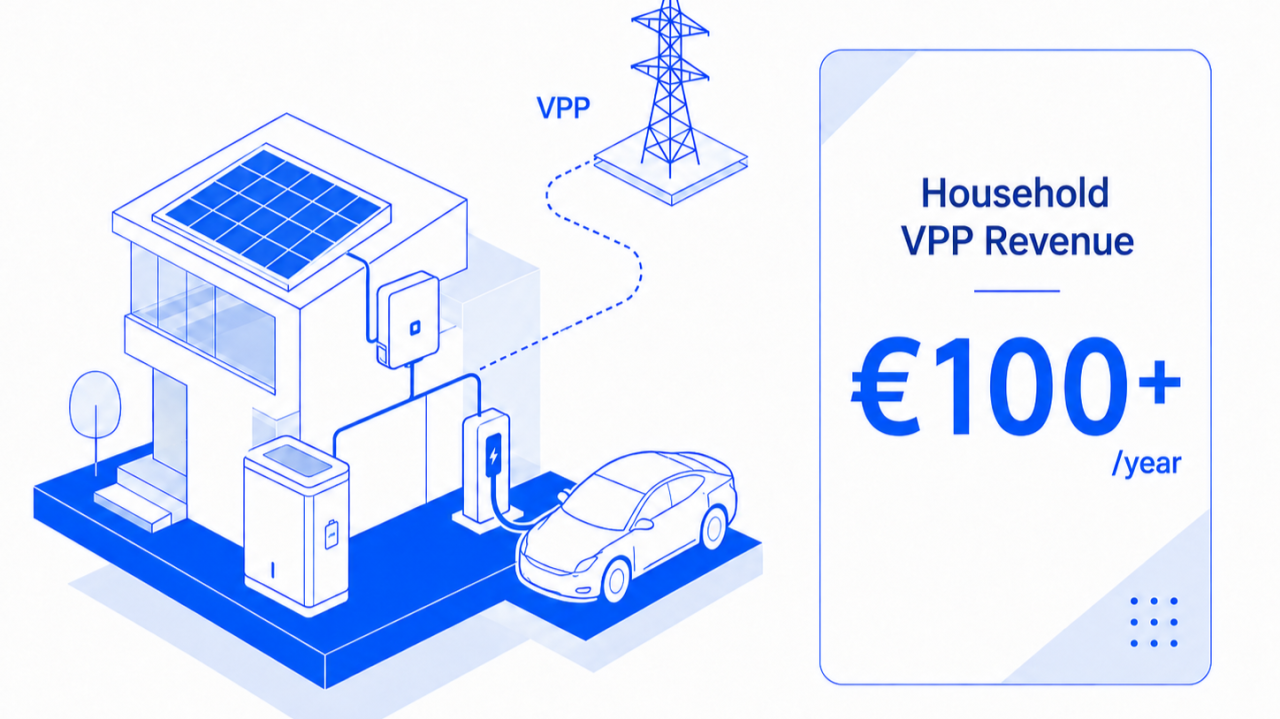
For certain projects, the guaranteed baseline earnings target can reach approximately €100 per household per year.
UltimateBox can also support direct contractual arrangements with Chinese OEM partners, allowing them to integrate both VPP participation capabilities and tangible end-user earnings directly into their own product offerings.
Eligible households can earn €100+ per year from VPP participation.
2. UB_Box 300 Whole-Home Orchestration + AI Unlocks Greater Revenue Potential
Baseline VPP earnings are only the first step.
When a household is equipped with UB_BOX 300, UltimateBox can bring the battery, EV, and additional flexible household devices into a unified energy orchestration system.
The more flexible resources that can be coordinated within a household, the greater its potential contribution to VPP programs.
At the same time, AI-driven energy strategies optimize dispatch based on:
PV generation forecasts
Home load forecasts
Dynamic pricing
Battery SOC
EV SOC
User mobility requirements
Minimum SOC settings
Backup power requirements
While ensuring users’ mobility and backup power requirements are met, AI can further increase available household flexibility and improve dispatch efficiency.
AI continuously seeks a better balance between normal household energy use, electricity cost optimization, and VPP revenue.
Take the partner’s 7 kW residential Hybrid Converter with V2X as an example.
In markets such as the UK, where conditions for V2G deployment are already emerging, the EV — the household’s “second battery” — can also be incorporated into VPP dispatch.
Under suitable market mechanisms, vehicle availability, flexible capacity, and dispatch conditions, the VPP revenue potential per household could increase to approximately €500–€700 per year, or potentially higher.
The value of V2X for residential energy storage brands should go beyond a simple line on a product datasheet that says:“Supports V2G.”
True productization means combining: V2X + HEMS + AI + VPP ,to turn bidirectional charging capabilities into tangible energy value that end users can actually experience.
Inside the home, V2H can provide backup power and help reduce electricity bills.Outside the home, V2G and VPP participation can create additional revenue opportunities.
End users gain more value, while the product gains a clearer competitive advantage.
Ⅳ. Make the Value Visible. Turn V2X into Real Product Competitiveness.
V2X is moving from technical validation toward commercial product deployment.
As bidirectional charging hardware, communication standards, grid-connection mechanisms, and VPP business models continue to mature, the industry is entering a critical window for planning the next generation of products.For residential energy storage brands, preparing for V2X today is no longer simply about reserving an interface for some distant future.
By pairing mature Hybrid Converter with V2X hardware with UltimateBox HEMS, brands can already integrate the EV as a household’s “second battery” into the home energy management system.This enables a complete set of capabilities around:V2G, V2H, smart charging, AI energy optimization, and VPP dispatch.This turns a market trend into real product competitiveness that can be sold, deployed, and experienced by users.
A key unit of competition in the future residential VPP market will be:How much flexibility value can each household unlock?
The competition will not simply be about how many households are connected, nor merely how many devices are integrated.What matters is who can coordinate more PV, Battery, EVs, and flexible loads within each home — while still meeting users’ mobility, backup power, and normal energy needs — and unlock more stable and predictable flexible capacity.
The more flexible capacity each household can provide, the greater the potential for both electricity cost optimization and VPP revenue.When aggregated at scale, this also increases the value of the energy asset portfolio available to the brand.
Ultimately, these complex energy management capabilities need to be translated into value that end users can clearly understand and experience.
Whole-Home Energy at a Glance
The UltimateBox User App brings PV, Battery, EV, Home, and Grid into a single home energy interface.Through a 3D home energy flow visualization, users can see the real-time energy relationships between different devices.
Savings & Earnings, Clear at a Glance
For users, what matters more than “how many kWh were charged or discharged today” is: How much money has the system actually saved me, and how much additional value has it generated?
UltimateBox converts complex energy data into clear, intuitive value outcomes.Users can see not only how much they have saved on electricity and how much VPP revenue they have earned, but also where that value came from:AI energy optimization, dynamic electricity tariffs, V2H, or VPP dispatch.
Don’t just show users how much they saved. Show them how every part of that value was created.
Preparing for V2X today means securing an early position at the gateway to residential energy flexibility, while continuously building flexible energy resources for future VPP competition.
Ⅴ. V2X Doesn’t Have to Start from Scratch
For residential energy storage brands planning their next generation of products, V2X no longer needs to be built from scratch.
By combining UltimateBox’s intelligent energy management solution with its partner’s multi-market-certified Hybrid Converter with V2X hardware, B2B energy brands can accelerate the development of competitive Solar + Storage + EV Charging + V2X product offerings and build a complete home energy solution that helps end users achieve lower electricity bills and access more revenue opportunities.
UltimateBox provides global energy equipment brands with end-to-end technical capabilities spanning HEMS, AI-powered energy scheduling, DER aggregation, and VPP integration.
If you are planning your V2X roadmap, or looking for VPP and home energy management solutions, we invite you to connect with our team.