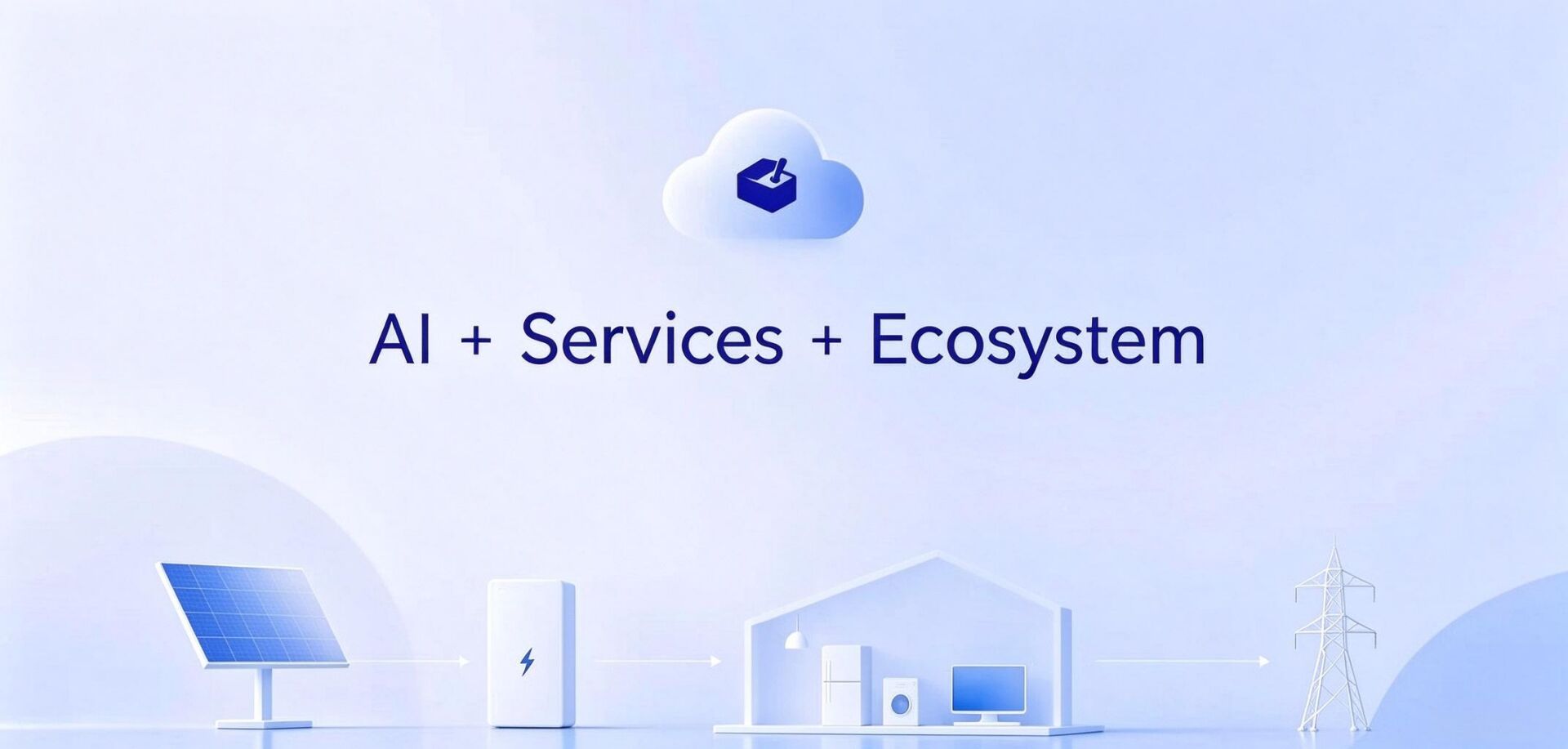
As Residential Energy Storage Enters the “AI + Ecosystems + Services” Era, How Can Hardware–Software Decoupling Give Brands Greater Control?
In the early days of residential energy storage, user needs were relatively straightforward.
The basic cloud platforms and apps supplied with inverter data loggers and communication modules were sufficient for brands and end users to monitor device status.
As more energy service providers enter the residential market, the service model for home energy systems is changing.
Dynamic tariffs, demand management, energy savings, virtual power plants (VPPs) and Australia’s Flexible Trading Arrangements (FTA) are creating new demands for smarter energy strategies; at the same time, coordinating solar PV, energy storage, heat pumps and EV charging across the home is making the energy ecosystem more complex.
Trends at the recent 2026 energy exhibition in Munich point to a shift in Europe’s storage market: competition is expanding beyond hardware specifications to encompass capabilities in AI, device ecosystems and energy services.
Residential storage systems built primarily around device monitoring can no longer fully support this shift.
For brands, future competitiveness depends on more than the equipment itself: it also requires the ability to build device ecosystems, introduce intelligent energy strategies and continuously expand energy services for end users and partners.
This calls for a product architecture that supports rapid, ongoing development, allowing hardware and software platforms to be selected and upgraded independently so that tight coupling does not constrain business innovation or platform expansion.
Ⅰ. The UltimateBox Approach to Hardware–Software Decoupling
Our solution decouples inverter data loggers and communication modules from cloud platforms, apps and other business systems, enabling brands to build and continuously improve their own complete energy systems independently of their choice of hardware supplier.
We often hear how quickly China’s new generation of fighter jets is evolving.
One important principle behind this is to avoid tying software capabilities too closely to a particular hardware platform.
Decoupling the hardware and software platforms allows aircraft hardware development and mission-system software updates to progress independently, with each supporting rather than constraining the other.
Software and algorithms can then be upgraded without redeveloping the underlying hardware or the entire aircraft each time.
An architecture that can evolve in this way allows new capabilities and features to be integrated and deployed quickly.
The same principle applies to residential storage brands: data loggers, communication modules and software platforms can be selected and upgraded independently.
A brand can source communication modules from Supplier A and data loggers from Supplier B.
It can later switch to other suppliers based on cost, lead times, regional market requirements or project needs.
As hardware changes, device data, remote control capabilities and customer service systems can remain within the brand’s own platform, while its cloud platform, apps, AI energy strategies and energy services continue to evolve with market needs.
Ⅱ. What Hardware–Software Decoupling Means for Brands
1. Managing Supply Chain Risk: Protecting Your Systems from Supplier Changes
Data loggers, communication modules and their associated cloud platforms are more than one-off deliverables: they form the digital infrastructure that supports equipment throughout a service life of more than a decade.
Over the long life of an IoT deployment, changes affecting a supplier can create risks that are not immediately apparent.
For example, when a cloud service provider for smart locks used in rental apartments went out of business, the locks repeatedly retried data transmission and searched for a network connection, rapidly draining their batteries and generating substantial costs for maintenance labour and replacement batteries.
For larger businesses, these costs can accumulate to a considerable sum.
The same applies to inverters and other energy storage equipment that must operate and be supported for many years: brands remain responsible for serving their customers over the long term.
Customer data and device control both depend on cloud services.
When hardware is tied to a supplier’s cloud platform, changes in that supplier’s business circumstances, partnership arrangements or product roadmap can lead to a loss of remote access to or control over devices, creating significant business risk.
The UltimateBox architecture allows cloud platforms, data loggers and communication modules to be replaced and upgraded with greater independence.
The UltimateBox cloud platform also supports hardware from multiple brands.
This helps brands maintain stable business systems when their hardware supply chain changes, strengthening data protection and supply chain resilience.
2. Greater Cost Transparency and Control
Decoupling allows data loggers and communication modules to be procured independently.
Brands can choose suitable suppliers in line with their own supply chain strategies, considering price, lead times, regional certification requirements, project needs and supply reliability.
Their purchasing decisions no longer have to be dictated by dependencies built into a third-party solution.
Brands can assess hardware costs independently, with a clearer view of their cost structure.
3. Enabling Future Business Expansion
Hardware–software decoupling gives brands both the freedom to choose data logger and communication module suppliers today and the ability to develop and adapt their businesses quickly as new challenges emerge.
International energy markets are changing rapidly, and tariff structures, user needs and energy service models differ from country to country.
Brands need the underlying capabilities to keep adapting to market changes and continuously improving their products and services.
However, many early platforms were built around monitoring individual devices or supporting a fixed hardware configuration, which can create limitations:
The development of new business capabilities is constrained by the existing scope of the third-party platform.
When hardware and software are tightly coupled, long hardware development cycles can slow the software platform’s ability to respond to market, user and business needs through rapid updates and continuous improvement, affecting the brand’s product roadmap and business strategy.
With an open cloud platform architecture, UltimateBox provides brands with a technology foundation that can evolve over time and support rapid updates as markets change.
The platform connects solar PV, energy storage, heat pumps, EV chargers and other devices from multiple brands, with capabilities that can be expanded according to business needs to include AI-powered energy dispatch, coordination across the device ecosystem, management of installation, operations and maintenance (O&M), VPP integration and resource aggregation for VPPs.
Alongside hardware choice, brands gain energy management capabilities spanning AI, device ecosystems and services that can be built quickly and continuously improved, helping them respond flexibly to market changes and strengthen their overall competitiveness.
Ⅲ. Source Code Delivery: Giving Brands Control of Their Systems
The UltimateBox IoT platform is available separately, enabling brands to decouple data loggers and communication modules from the cloud platform.
UltimateBox also offers several platform delivery and support options to meet brands’ needs at different stages of growth.
Source code delivery: Available for projects requiring in-house development or extensive customisation.
Implementation services: We provide end-to-end support for commercial rollout, including platform deployment, device onboarding, system integration and custom development.
Private cloud deployment: Helping brands build software platform capabilities with greater independence and control.
These options put control of the system back in the brand’s hands.
Ⅳ. Optional Value-Added Capability: AI-Powered Energy Dispatch
The system also offers an intelligent energy dispatch mode that combines local dynamic tariffs, solar PV generation forecasts and household load forecasts to automatically optimise charging, discharging and energy use, helping end users further reduce their energy costs.
Brands can choose whether to subscribe to this capability based on their business needs, independently of the platform services.
Ⅴ. Growing with Brands: The UltimateBox Approach to Long-Term Partnership
UltimateBox’s mission is to turn energy assets into continuous revenue.
We believe the value of distributed energy extends beyond a one-off equipment sale.
Solar PV systems, energy storage, heat pumps and EV chargers need ongoing connectivity, insight into their operating behaviour, dispatch and active management to evolve from installed hardware into energy assets that can support energy savings, energy arbitrage, demand response and energy trading.
UltimateBox therefore goes beyond standalone hardware or software to provide technology infrastructure that helps brands build the capabilities to operate distributed energy assets: edge connectivity brings different devices online, a unified platform and data foundation support the ongoing management of customers’ energy assets, and AI-powered energy dispatch lays the groundwork for future energy services, aggregation and trading.
The UltimateBox business model is built around this long-term value.
We earn revenue from subscriptions to AI energy strategies, our platform and the underlying technology infrastructure; hardware and core software provide the starting point for connecting and operating customers’ energy assets, while the value of the partnership continues beyond that initial deployment.
This gives UltimateBox and its brand partners aligned long-term incentives.
Brands seek to expand their installed base and customer base, extending one-off equipment sales into long-term customer relationships and energy services; UltimateBox seeks to provide ongoing connectivity, dispatch, aggregation and operational capabilities for the brands’ growing base of customer energy assets.
Brands retain their customer relationships, brand identity and market presence; UltimateBox provides the AI capabilities and technology foundation for energy operations.
As partners connect more customers’ energy assets, brands can build longer-lasting customer relationships and create more service opportunities, while UltimateBox can continue to deliver more valuable operational services.
That is why we take an open approach to partnering with brands: our customers go to market and serve users under their own brands, while UltimateBox provides the underlying technology, helping distributed energy businesses move from equipment sales to long-term operations.Turn Energy Assets into Continuous Revenue.