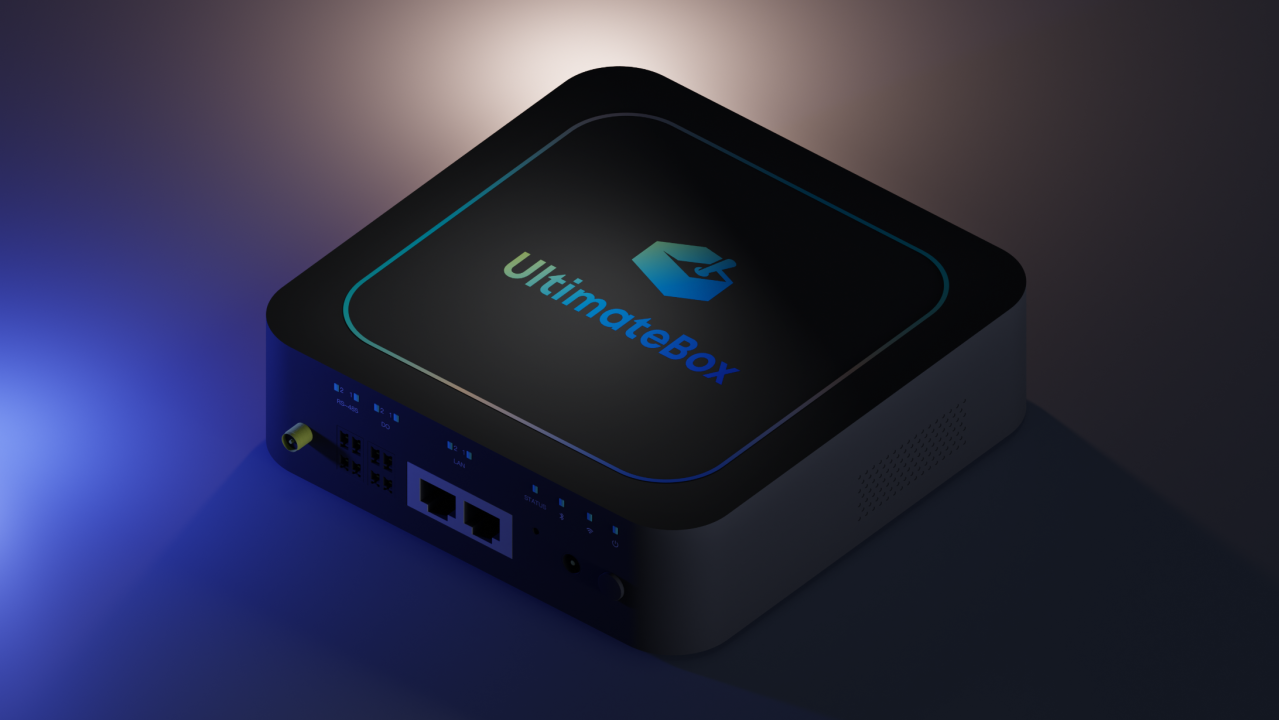
UltimateBox UB BOX :A Next-Generation Edge Intelligence Gateway for Home Energy Management
As dynamic tariffs, VPP participation, and home energy scheduling continue to scale, and as grid-friendly control requirements become increasingly stringent, home energy management needs more than just a device connectivity component. It requires a true system hub at the edge — one capable of real-time sensing, local computing, and responsive control.
Against this backdrop, UltimateBox is officially launching its next-generation smart gateway for home energy management — the UB_Box 300.
It is designed for the next stage of home energy management — moving from simple device connectivity to true system coordination — by adding the critical edge-side capabilities needed for intelligent dispatch, VPP participation, multi-device coordination, and future scalability.
Historically, home energy management was largely focused on getting devices connected. Today, the challenge is no longer just about integration — it is about enabling real-time sensing, more reliable execution, more efficient coordination, and the flexibility to support future expansion.
In other words, cloud-only architectures and basic data collection methods are no longer sufficient for the next stage of home energy management. To support more complex and real-time operational needs, part of the system’s sensing, computing, and response capabilities must move closer to the site.
This is exactly why UltimateBox launched the UB_Box 300. As the edge intelligence hub of the home energy system, it helps move the system beyond basic connectivity toward real-time sensing, local execution, coordinated control, and long-term scalability.
Specifically, the UB_Box 300 strengthens four critical capabilities.
1. UB_Box 300.
Strengthening the Critical Edge Capabilities of Home Energy Systems
A. UltimateBox AI Smart Dispatch + UB_Box 300: Taking Intelligence to the Next Level
AI-driven smart dispatch uses inputs such as global dynamic tariffs, PV forecasts, and load forecasts to determine the optimal times to charge and discharge. This enables more efficient charge-discharge strategies and helps end users optimize their electricity costs.
However, as home energy systems evolve beyond the inverter and battery to include EV chargers, heat pumps, and other flexible devices, the optimization challenge is no longer just about charge and discharge. It becomes a much more complex task of coordinating multiple devices across the household energy system.
As an edge-side control node, the UB_Box 300 enables coordinated control across multi-brand PV, battery storage, heat pumps, and EV chargers. It can also extend to a wider range of household loads, including pool thermostats and VRV systems, allowing AI-driven smart dispatch to scale across more comprehensive home energy scenarios.
At this point, AI-driven smart dispatch is no longer just about optimizing individual devices. It becomes a whole-home orchestration capability that coordinates more devices across more scenarios. On top of improving the performance of existing operating strategies, it unlocks additional energy-saving potential through multi-device collaboration — expanding the value of smart dispatch and moving toward a more complete vision of intelligent whole-home energy management.
B. High-Frequency Data Acquisition: Stronger Support for Remote After-Sales Service
Many equipment anomalies are not continuous in nature — they occur only within very short time windows.
If the data acquisition interval is too long, transient signals — such as inverter faults or voltage fluctuations — can easily be missed.
For example, an anomaly may last only a few hundred milliseconds or a few seconds. But if data is sampled only every few minutes, the backend may still record what appears to be completely normal data.
Through second-level data acquisition, the UB_Box 300 delivers continuous access to more granular device operating data, making it easier to capture transient fault signals and identify on-site changes such as power fluctuations or abnormal load behavior. This gives remote after-sales teams stronger diagnostic support, helping engineers assess issues more accurately and pinpoint faults more efficiently.
C. Edge-Side Response: Why VPP Needs the UB_Box 300 Even More
As residential battery storage, flexible household loads, and EVs continue to expand, an increasing number of home energy systems are becoming potential participants in VPPs.
In VPP applications, the real measure of system value lies in response speed, execution certainty, and the ability to reliably deliver. Different market products impose different timing requirements, and cloud-only real-time dispatch can easily be affected by network instability, latency, or timeouts.
By shifting critical computing and fast-response capabilities closer to the edge, the UB_Box 300 allows the system to execute different control paths for different VPP market products and respond directly to grid dispatch signals. This creates a stronger foundation for stable and reliable delivery in VPP applications where response requirements are especially demanding.
Building on this, the UB_Box 300 enables participation in a wider range of VPP market products, helping partners take on more diverse market opportunities and dispatch requirements with greater efficiency.
At the same time, UltimateBox’s cloud-edge collaborative architecture ensures that the system can still dispatch efficiently and participate in energy trading even as it scales to large volumes of flexible assets such as PV, battery storage, and EV charging. This helps avoid dispatch failures and trading losses caused by technical bottlenecks in the system architecture.
D. Broader Expansion: From PV, Storage, Heat Pumps, and EV Charging to Wider Household Load Coordination
As more controllable devices enter the home energy ecosystem, it becomes increasingly important to leave room for future expansion.
Another key value of the UB_Box 300 is that it is built not only for current use cases, but also for the future evolution of the home energy ecosystem.
As a unified edge-side node for the home, it helps the system integrate, translate, and coordinate a wide range of devices. This lowers the complexity of future expansion and enables home energy management to move beyond PV, storage, heat pumps, and EV charging toward broader coordination across household loads.
This also means greater business scalability:
• For distributors, it opens up more sales opportunities;
• For load aggregators, it means access to more controllable and flexible loads;
• For residential energy storage brands, it provides the foundation for expanding into more user scenarios — from V2G and V2H to more advanced energy-saving strategies.
• For end users, this means the home energy system is no longer a one-time, closed installation, but an open platform that can continue to evolve. As new devices such as smart plugs, home thermostats, and pool thermostats are added over time, they can be brought more easily into a unified energy management framework.
The UB_Box 300 home energy gateway is designed not only to connect the devices of today, but also to leave the door open for the devices and use cases of tomorrow.
2.From Home Energy Management to Grid-Friendly Operation and Overseas Readiness
While multi-device integration expands the range of scenarios a home energy system can support, grid-friendly control and overseas market adaptation raise the bar even further for system-level coordination and adaptability.
Germany is a clear example of this shift. In the context of §14a and EEBus, the market is no longer asking only whether devices can connect, but whether the entire system can deliver grid-friendly control in a more efficient, coordinated, and scalable way.
This is also why the value of edge gateways continues to rise. For manufacturers, whether a central hub can unify control logic, protocol translation, and multi-device coordination will directly shape how efficiently products can be deployed — and how well they can adapt to different market requirements.
This is exactly the kind of system-level challenge the UB_Box 300 is designed to address.
As the edge intelligence hub of the home energy system, it serves as a central layer for control logic and protocol translation, helping the system build compatibility and future expansion capabilities around Modbus, OCPP 2.0, SG Ready, EEBus, and evolving V2G/V2H use cases. This enables partners to address a wide range of application needs more efficiently, from device interoperability and EV charging communication to heat pump management and bidirectional energy flow between vehicles and the grid.
At its core, the significance of the UB_Box 300 goes far beyond support for more protocols.
More importantly, with the right standard interfaces and control logic built in, an edge gateway like this enables the system to meet grid-friendly control requirements more efficiently, simplify multi-device integration, and create a more solid foundation for the future of coordinated home energy management.
3. Beyond Dispatch: Ease of Deployment and O&M Also Matters
Installation and delivery are a critical cost factor in residential energy storage. That is why the UB_Box 300 is supported by a dedicated installer app and workflow system, helping partners reduce both installation and training costs while building the delivery capacity needed for faster business expansion.
Built for real-world delivery scenarios, the UB_Box 300 supports LAN-based networking, with RS-485 and CAN interfaces designed to balance device connectivity and on-site deployment efficiency. This helps simplify installation, with network setup taking as little as two minutes. It can also be extended with communication options such as Wi-Fi Mesh and LoRa, allowing partners to adapt the system to different project requirements and deployment scenarios.
From an O&M perspective, the UB_Box 300’s high-frequency data acquisition provides a more timely data foundation for remote operations and anomaly detection. Combined with remote diagnostics, it further improves after-sales service efficiency.
From deployment and operation to long-term service, UltimateBox places strong emphasis on real-world deliverability. While helping improve on-site deployment efficiency, it also provides stronger support for system stability and easier ongoing O&M.
Home energy management is entering a new phase.
At this stage, home energy systems need more than a simple connectivity layer. They require a true edge-intelligence foundation — with sensing, computing, response, and long-term scalability built in.
It needs to do more than connect to the site — it must be able to understand on-site conditions and carry out control strategies accordingly. It should support today’s needs for energy savings and dispatch, while also creating the foundation for future capabilities such as VPP, demand response, grid-friendly control, and wider coordination across connected devices.
The launch of the UB_Box 300 reflects UltimateBox’s latest product upgrade in response to the evolving needs of home energy management.
With stronger edge capabilities built closer to real-world application scenarios, we aim to support our partners more effectively in device coordination, intelligent dispatch, and future system expansion.
We also look forward to working with our partners to continuously refine and improve through real-world deployment, so that home energy management can deliver greater long-term value across a wider range of practical scenarios.